
Bulldog Family,
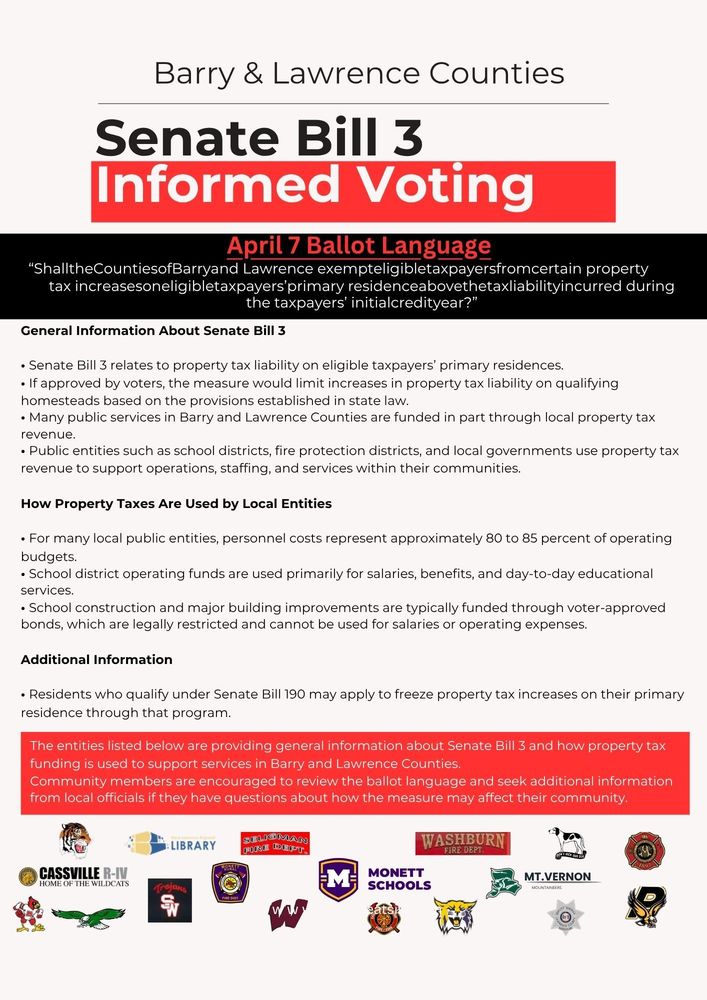
As the April 7 election approaches, I want to take a moment to share clear, straightforward information about Senate Bill 3 and what it could mean for the Wheaton R-III School District and for public education as a whole. This ballot issue proposes limiting how much property taxes can increase on a homeowner’s primary residence, an idea that many understandably view as positive. After all, everyone wants to pay less in taxes. However, there is more to consider.
If approved by the voters, Barry County and McDonald County will be classified as 0% growth counties, which means that if SB 3 passes, property tax revenues for local taxing entities would be permanently locked at their FY24 levels. This would freeze the total amount of property tax collected each year, regardless of future increases in property values, new construction, or inflation. As a result, schools, emergency services, and other local government operations would not see revenue growth from property taxes over time, leading to budget constraints, reduced services, or increased reliance on alternative funding sources to keep up with rising costs. Newton County would be classified as a 5% growth county, meaning that the tax bill on a private dwelling could not increase more than 5% in a given year. Effectively, Newton County residents would see their tax bills increase slightly over time, leading to their contributing more to the District than a family living in McDonald or Barry County would. This disparity is actively being challenged in court, though the measure was allowed to proceed to the ballot box in April.
Why does this matter to our schools?
Property taxes play a critical role in funding our schools. At Wheaton, they account for approximately 35% of our total revenue, directly supporting staff salaries and benefits, classroom resources, student programs, and the day-to-day operations that keep our district running. When local revenue is limited, it has an immediate impact on our ability to sustain these essential services. This challenge comes at a time when school districts across Missouri are already facing significant financial pressures, including a projected $138 million state budget shortfall, potential per-student funding decreases of several hundred dollars, and a funding formula that is already underfunded by approximately $190 million. In addition, transportation funding is expected to decline while other funding sources remain flat, even as costs continue to rise without matching increases in support. At the same time, schools are being asked to do more, meeting new mandates, enhancing safety measures, providing additional services, and expanding academic expectations without additional funding.
What This Means for Us
When you put all of this together, districts like Wheaton are facing tighter budgets, difficult decisions about staffing and programs, and increased pressure to do more with fewer resources. Local funding decisions, including those tied to property taxes, are a critical piece of whether we can continue to provide the level of education our students deserve.
A “yes” vote would approve the proposed limits on how much property taxes can increase on a homeowner’s primary residence. For taxpayers, this could provide more predictability and protection from rising property tax bills. However, because local school districts rely heavily on property tax revenue, limiting those increases would slow the growth of funding available to districts like Wheaton. Over time, this may affect how schools plan for expenses such as staffing, programs, and facility needs, particularly if costs continue to rise.
A “no” vote would keep the current system in place, allowing property tax revenues to continue adjusting based on existing laws and local assessments. This means school districts would maintain their current funding structure and capacity for revenue growth tied to property values. At the same time, homeowners could continue to see property tax increases if property values rise with the safeguards already in place remaining.
Our Focus Moving Forward
I encourage you to stay informed, review the ballot language, and understand how these issues connect to the work that schools and community service entities do every day. We will continue to prioritize students and staff, be responsible with our resources, and communicate openly about challenges and decisions
Please contact me if you have any further questions about Senate Bill 3.
Mr. Chris Paullus
Wheaton R-III School District Superintendent
cpaullus@wheatonschools.org
*Credit to Merlyn Johnson, Cassville R-IV School District for contributions